The Hungry Ghost Festival is the seventh month of the lunar calendar, which in 2026 runs from Thursday 13 August to Thursday 10 September. Taoist and Buddhist tradition holds that during these weeks the gates of Hell open and spirits return to roam among the living. The peak day, Zhong Yuan Jie, falls on the fifteenth of the month: Thursday 27 August 2026.
In Chinatown, the month is quieter than its name suggests. The big getai stage shows mostly follow the housing estates, not the tourist districts. What the district has instead is the temples. Buddha Tooth Relic Temple at 288 South Bridge Road observes the month as Ullambana, the Buddhist form of the festival, and a short walk beyond the district on Phillip Street, Yueh Hai Ching Temple holds its Seventh Lunar Month Prayers on the peak day itself.
In brief: The Hungry Ghost Festival (Zhong Yuan Jie) spans the seventh lunar month, 13 August to 10 September in 2026, when Taoist and Buddhist belief holds that spirits return to the living world. Offerings and joss-paper burning go on across Singapore all month, peaking on 27 August. The big getai stages are typically in heartland housing estates rather than Chinatown; Buddha Tooth Relic Temple in the district observes Ullambana, and Yueh Hai Ching Temple, a short walk away on Phillip Street, holds Seventh Lunar Month Prayers on the peak day. As of early August 2026, neither temple had published its 2026 programme.
When is the Hungry Ghost Festival in 2026?
The seventh lunar month begins on Thursday 13 August 2026 and ends on Thursday 10 September 2026. Zhong Yuan Jie, the fifteenth day and the festival's high point, falls on Thursday 27 August 2026. These dates follow the Hong Kong Observatory's Gregorian-lunar calendar conversion table.
The festival is not a single day off work or a gazetted holiday. It is a month-long observance, and the practices that come with it, the offerings, the burning, the prayers, run through the whole period.
What is the Hungry Ghost Festival?
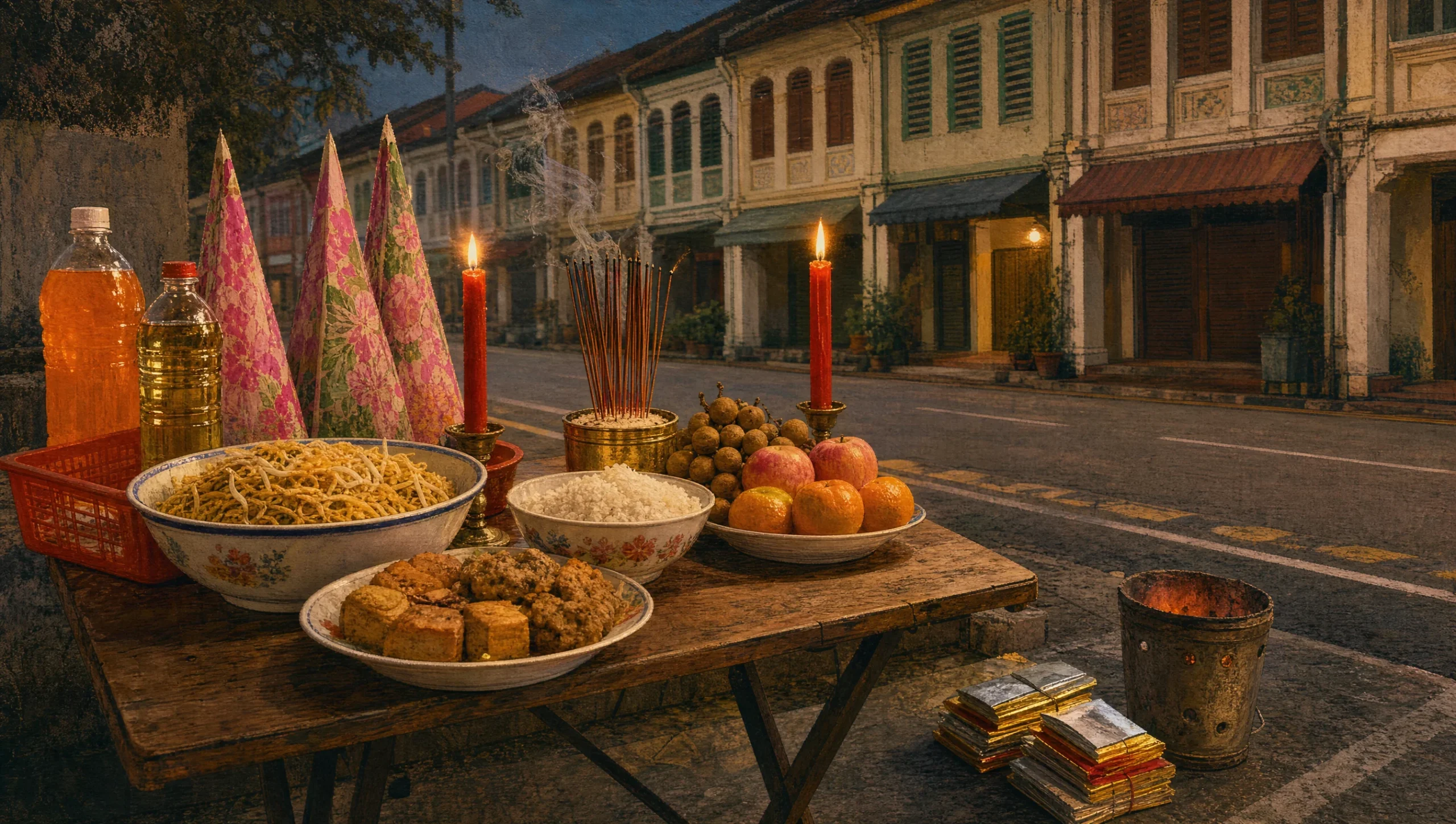
Zhong Yuan Jie, the Hungry Ghost Festival, is observed by Chinese Buddhists and Taoists who believe that during the seventh month the gates of Hell are opened, releasing spirits who roam the earth. That is how the National Heritage Board records the belief, and the practices follow from it. Believers burn joss sticks and paper offerings and set out food for the spirits. Offerings are also left for wandering ghosts along roadsides and other passing points, which is why plates of rice and fruit appear at kerbs and stay there untouched.
The month carries two names because two traditions observe it. Zhong Yuan Jie is the Taoist name. Buddhists observe the same period as Ullambana, which rests on the story of the monk Maudgalyayana, who held a mass to relieve the suffering of his mother in the realm of hungry ghosts. Chinatown's Buddha Tooth Relic Temple teaches this story as the foundation of its own observance.
What will visitors see during the month?
Small fires and full plates. Joss paper burns in designated burners through the month, and food offerings sit out where the spirits are thought to pass.
The Taoist Federation (Singapore) and the Singapore Buddhist Federation, together with the Alliance for Action on Norms for Joss Paper Burning, have issued a joint advisory, hosted on the National Environment Agency's website, asking devotees to burn joss paper in designated or personal burners, in small quantities, and to avoid burning directly on grass, walkways or driveways. The advisory also notes there is no need for the customary throwing of joss paper into the air. Those guidelines describe what the month looks like on the ground: contained fires, deliberate offerings, and a practice that has adjusted itself to a dense city.
For everyone else, the etiquette is simple. Offerings at a kerb are not litter. Walk around them, not over them, and leave the burners room to do their work.
Where are the getai shows?
Mostly not in Chinatown. Getai, the open-air song-stage shows that mark the festival's nights, are typically performed in temporary tent and stage setups at open fields in public housing estates, which is where the National Heritage Board places them. The shows entertain the spirits and the living at once, and the front row of seats is left empty for the audience nobody can see. As of early August 2026, no published getai schedule named a venue inside Chinatown.
The form itself has deep Singapore roots. Da Ye Hui, which performed at the New World Amusement Park in the 1940s, is regarded as Singapore's first getai. The Singapore Chinese Cultural Centre's account of the scene records that the number of shows held in the seventh month fell from over 300 before the pandemic to about a hundred afterwards. The National Heritage Board's record complicates the easy story of a dying tradition: the share of Buddhists and Taoists in Singapore has been gradually declining and believers skew towards middle age, yet an increasing number of young performers have joined the getai circuit, and their presence has drawn younger audiences with them.
How do temples in and near Chinatown observe the festival?
Buddha Tooth Relic Temple, at 288 South Bridge Road in Kreta Ayer, observes the month as Ullambana. The temple's own teaching materials trace the observance to Maudgalyayana's rescue of his mother, and it has publicised Ullambana ceremony schedules before; its 2019 timetable is still on its Facebook page.
Yueh Hai Ching Temple, also written Wak Hai Cheng Bio, stands at 30B Phillip Street, a short walk beyond the district's edge. It is managed by the Ngee Ann Kongsi, the Teochew clan body, and the Kongsi's calendar for the temple lists Seventh Lunar Month Prayers on the fifteenth day of the seventh month. In 2026 that is Thursday 27 August, the peak of the festival.
As of early August 2026, neither temple had published a 2026 programme with ceremony times or public arrangements. Checking their pages closer to the dates is the reliable way to catch the schedule.
A month worth walking through
The seventh month ends on 10 September, the burners cool, and the kerbs clear. Until then, the festival asks almost nothing of a visitor beyond a little care about where they step and a willingness to let the offerings be. Anyone in the district on 27 August will be within a short walk of the Seventh Lunar Month Prayers at Yueh Hai Ching Temple, a standing date on the temple's calendar. That is the version of the festival Chinatown can honestly offer.
The observances do not stop with the seventh month either. The
Mid-Autumn Festival follows in the next lunar month, the
history of Chinatown explains how the district came to keep this calendar, and the rest of the district's guides are collected under
news and articles.